Pakistan’s Revised Auto Policy Combines EV Tax Relief With Tougher Assembly Rules
-
Mustafa Ali Khan
-
- Published October 21, 2026
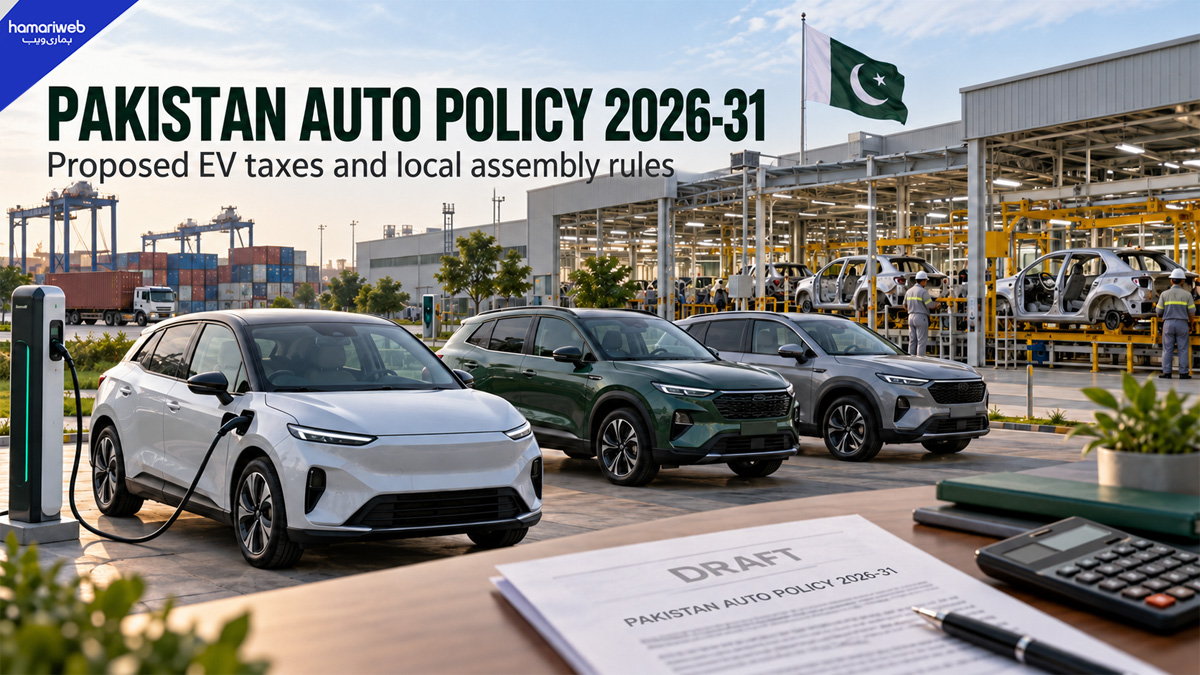
Pakistan’s revised auto policy proposes separate sales taxes for battery EVs, range extenders and plug-in hybrids. Assemblers face rising local production and export requirements. The prime minister has approved the draft, but further approvals stand between the proposals and implementation.
Pakistan’s previous auto policy ended on June 30, leaving carmakers awaiting a replacement framework for taxes and manufacturing incentives. The latest presentation sets out a five-year plan covering vehicle imports, local assembly and exports.
Prime Minister Shehbaz Sharif approved the draft on October 20. The Express Tribune reports further review by the International Monetary Fund, Pakistan’s lender, and federal cabinet approval still lie ahead. Parliament would then need to pass legislation giving effect to the proposed tax changes.
Three EV Types With Three Tax Rates
The draft divides new energy vehicles (NEVs) into three groups, proposing 1% sales tax on battery EVs, 6% on range extenders and 9% on plug-in hybrids. These rates would cover eligible imported and locally assembled vehicles. Ordinary hybrids without external charging would follow conventional vehicle tax treatment.
Battery EVs run entirely on stored electricity. A range extender uses a fuel-powered engine primarily to generate electricity for electric motors. A plug-in hybrid combines an externally rechargeable battery with an engine capable of powering the wheels. Earlier drafts offered different rates, including a reported 1% proposal for range extenders.
Small imported EVs with a cost, insurance and freight value below $15,000 would receive 5% customs duty for the first two years. Specified EV parts imported for local assembly would qualify for 1% customs duty. These duties are separate from sales tax on the finished vehicle.
Other proposed relief covers excise duties, capital value tax and withholding tax for qualifying NEVs. Vehicles worth more than $75,000 face separate excise treatment. The wider plan would reduce customs duty on conventional car and SUV imports to 15% by FY2030-31, with no additional or regulatory duty.
The draft also asks the State Bank of Pakistan, the country’s central bank, to consider raising the NEV financing limit from Rs. 30 lakh to Rs. 1 crore. Repayment would extend from three years to five. Revised central bank lending rules would need to follow before banks offer these terms.
Local Assembly Comes With Export Obligations
Manufacturers seeking support would face minimum domestic value addition requirements, measuring the share of a vehicle’s value created within Pakistan.
The presentation defines newer manufacturers as companies beginning production in 2016 or later. Their proposed targets for conventional cars, SUVs, jeeps and double-cab vehicles rise from 20% in FY2026-27 to 25%, 30%, 35% and 40% over the following four years. NEV targets follow 10%, 10%, 15%, 20% and 25%.
Older manufacturers face separate requirements. Companies already above the minimum would need to maintain each model’s existing local value. Missing applicable targets would remove export incentives and reduce concessions on imported non-localised parts by three percentage points. The draft also proposes customs and independent audits, supplier development, technology transfer and technical training.
The presentation projects about $6 billion in cumulative exports across five years. Parts makers account for roughly $3.29 billion, with vehicle manufacturers contributing about $2.72 billion through mandatory targets. The final year’s sector projection stands at about $2.19 billion.
Car, SUV, jeep and double-cab manufacturers would face export targets of 0%, 5%, 10%, 15% and 15% across the five financial years. These percentages apply to production value. Motorcycle and rickshaw targets follow 0%, 5%, 10%, 15% and 20%. Tractor targets follow 5%, 10%, 15%, 15% and 20%.
Eligible exporters would receive a proposed 5% base incentive. An additional 10% would apply to incremental exports if export value grew by at least 5% over the previous year. Conventional vehicle manufacturers face proposed financial penalties of 1% to 3% of annual production value, depending on category and year. Two consecutive years of missed export targets would put manufacturing certificates at risk.
A proposed Automotive Development Levy would fund export support and industry programmes. The passenger vehicle schedule lists 2% for engines from 1,001cc to 2,000cc and 10% above 2,000cc. Two- and three-wheelers, tractors and vehicles up to 1,000cc would receive exemptions.
The wider draft also proposes a 20% cap on booking advances, protection against company price increases after booking, and registration in the purchaser’s name before showroom delivery. A government tax increase would remain an exception to the proposed price protection.
Showroom prices still depend on the final tax measures, their commencement dates and manufacturers’ revised price lists. The presentation alone does not confirm savings on an existing booking.



Leave a Reply