Astronomers Discover a Possible Dwarf Planet Beyond Pluto
-
Ifrah Aqeel
-
- Published October 30, 2026
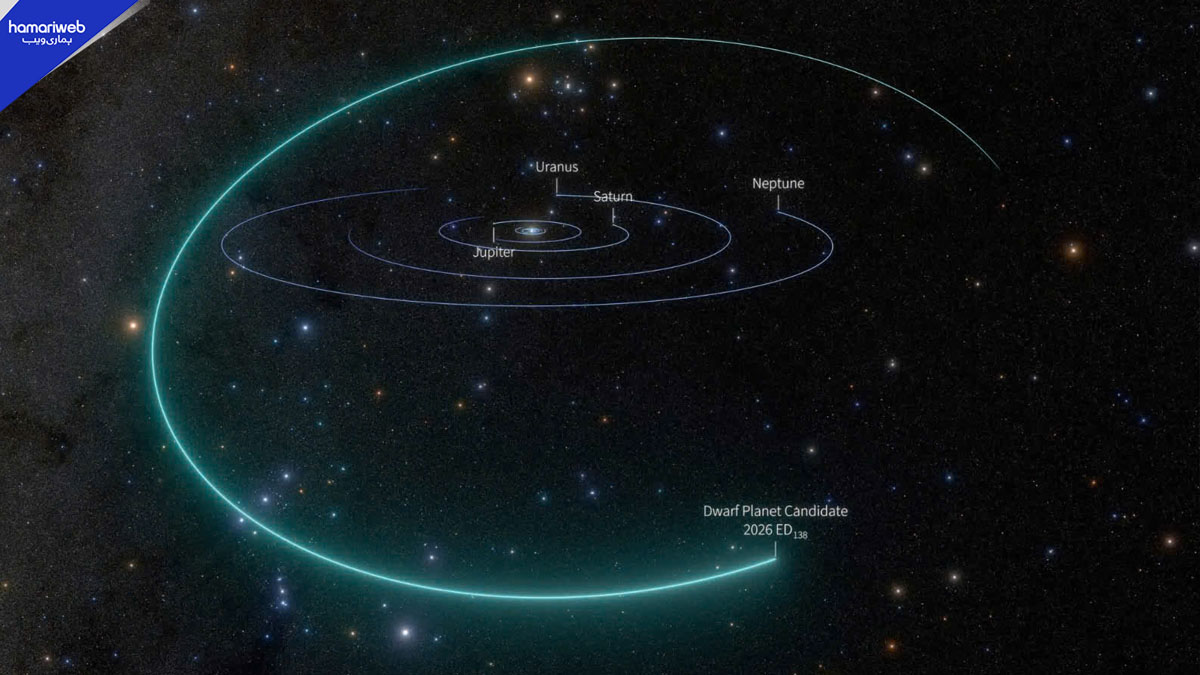
Astronomers have identified a possible new dwarf planet beyond Pluto using data from the Vera C. Rubin Observatory. Named 2026 ED138, the icy object could be one of the largest known dwarf planet candidates in the outer solar system.
The International Astronomical Union’s Minor Planet Center announced the discovery on October 27, 2026. Astrophysicist Matthew Holman of the Center for Astrophysics | Harvard & Smithsonian first identified the object while analyzing Rubin Observatory data on October 13.
ED138 lies about 46 times farther from the Sun than Earth. Pluto’s average distance is about 40 times the Earth-Sun distance, while Neptune orbits at about 30 times that distance.
Scientists estimate ED138 measures between 600 and 1,500 kilometers across. Its actual size depends on how much sunlight its surface reflects. Further observations, including infrared measurements, will help scientists determine its size and whether it qualifies as a dwarf planet
Why Astronomers Missed ED138 Until Now
ED138 sits in the Kuiper Belt, a region beyond Neptune filled with icy objects left over from the solar system’s formation. Its position near the plane of the Milky Way made it difficult to detect because countless background stars crowd this part of the sky
Rubin’s telescope and data-processing systems helped researchers identify the object among those stars. The team found 30 observations across 20 nights between March 4 and July 11, 2026. Archival images from another instrument also revealed ED138 in observations dating back to 2016. These records helped scientists trace more than a decade of its orbit.
The object’s orbit tilts about 25 degrees relative to the plane in which most planets orbit the Sun. Researchers believe gravitational interactions with Neptune may have altered its original path.
Could ED138 Become the Sixth Recognized Dwarf Planet?
A dwarf planet must orbit the Sun and have enough gravity to pull itself into a nearly round shape. It must also share its orbital region with other objects rather than clear that region of competing bodies.
The International Astronomical Union currently recognizes five dwarf planets: Pluto, Ceres, Eris, Haumea and Makemake. ED138 could become the sixth if further observations confirm its size and nature.
Scientists suspect its surface contains ice and reddish organic material, but its composition remains uncertain. The discovery also highlights the potential of the Rubin Observatory’s planned 10-year survey. In April 2026, the team reported more than 11,000 newly observed asteroids, including roughly 380 trans-Neptunian objects. Researchers expect repeated scans of the sky to reveal many more distant solar system bodies.
Ifrah Aqeel
Ifrah Aqeel is a news writer and editor covering entertainment, trending stories, and major national and international developments. She specializes in breaking down fast-moving news, viral trends, and current events into clear, engaging content. Backed by a disciplined editorial background, Ifrah brings a fast, factual, and research-driven approach to every story she covers.






Leave a Reply