Pakistan to train and deploy 400,000 workers for FIFA World Cup 2034 in Saudi Arabia
-
Shahzaib Dyer
-
- Published June 22, 2026
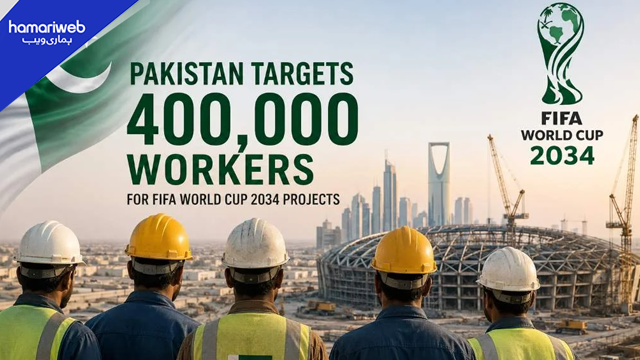
The government of Pakistan is preparing to train and deploy between 300,000 and 400,000 workers for large-scale development projects linked to the FIFA World Cup 2034 in Saudi Arabia, as part of a long-term strategy to expand overseas employment opportunities and strengthen its global labour market footprint.
The official planning documents state that the programme will help bridge the gap between the demand and supply of labour in Saudi Arabia’s infrastructure, aviation, tourism and service sectors over the period of 2026-2034.
Key Focus: Skilled Pakistani Workforce for Global Mega Projects
The workforce expansion plan is a component of Pakistan’s labour export policy designed to expand the scope and enhance the quality of workers working in Pakistan abroad.
According to officials, trained Pakistani professionals and labourers will be deployed to provide support:
- Stadium and infrastructure construction for FIFA World Cup 2034
- Aviation and transport sector development
- Hospitality and tourism services
- Large-scale urban development projects in Saudi Arabia
This effort is anticipated to substantially boost Pakistan’s contribution to mega-projects on an international level, especially those supported by investments from the Gulf region.
Soft Skills Training and Employment Growth in Pakistan
In July–March of FY2025–26, approximately 215,719 Pakistani workers were trained in soft skills for productivity, adaptability, and international employment.
Each year, there were 762,499 workers registered for overseas employment, according to the Bureau of Emigration and Overseas Employment.
The export of labour through official channels has been a long-standing tradition in Pakistan that has seen over 15 million nationals depart for work abroad since 1972.
Saudi Arabia Remains Top Destination for Pakistani Workers
Saudi Arabia continues to dominate as the leading destination for Pakistani migrant workers.
In 2025:
- Over 530,000 Pakistani workers were employed in Saudi Arabia
- The country accounted for nearly 70% of total overseas employment registrations
- Demand is driven by Saudi Arabia’s Vision 2030 infrastructure expansion
Other Gulf Cooperation Council (GCC) countries, including the United Arab Emirates, also remain key employment hubs for Pakistani workers.
Expansion Beyond the Gulf: Europe Labour Agreements
Pakistan is also strengthening labour mobility partnerships outside the Gulf region.
Under the Pakistan–EU Migration and Mobility Dialogue:
- Italy has allocated 10,500 job quotas for Pakistani workers over three years
- Germany is progressing toward structured skilled labour agreements
- Greece is exploring formal cooperation for workforce mobility
These agreements aim to diversify overseas employment destinations and reduce dependency on Gulf markets.
Digital Transformation of Overseas Employment System
To modernize recruitment and migration processes, Pakistan is implementing several digital reforms:
- Pakistan Emigrant Management Framework connecting 14 institutions
- Digital HR Pool system for job matching and biometric verification
- Online verification systems to improve transparency and reduce fraud
These reforms are designed to streamline overseas employment and improve efficiency in workforce deployment.
Remittances: Backbone of Pakistan’s Economy
Foreign Pakistani workers continue to be an important pillar of the national economy, with remittances being one of the highest foreign exchange earners after exports.
For the Government, labour exports are an important pillar of economic stability and long-term growth strategy.
As Saudi Arabia gears up for FIFA World Cup 2034 and a surge in infrastructure projects as part of Vision 2030, Pakistan is emerging as a key provider of skilled and semi-skilled labor for international ventures.
The initiative for the deployment of 20,000 to 400,000 workers abroad could revolutionize the Pakistani state of overseas employment, if executed properly, which will also increase remittance inflow and improve overseas labour relations.
Shahzaib Dyer
Shahzaib is content writer with over five years of professional experience. He is creative, hardworking, and possess extensive research skills. Being analytical in approach is highly reflected in his writing.






Leave a Reply