US-Iran Peace Deal: What Are the 14 Key Points of the Islamabad Memorandum?
-
 Syeda Qandeel Zehra
-
Syeda Qandeel Zehra
-
- Published June 18, 2026
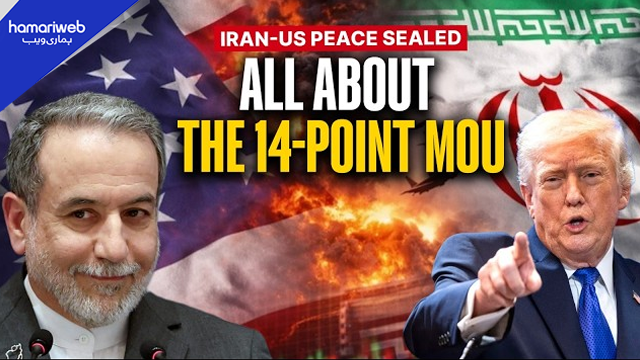
The United States has released the details of a 14-point Memorandum of Understanding (MoU) with Iran, titled the “Islamabad Memorandum.” According to U.S. officials, the agreement outlines a framework for a potential peace deal between Washington and Tehran, covering issues including ceasefire arrangements, sanctions relief, nuclear commitments, maritime security, and economic reconstruction.
The first element of the memorandum states that the United States, Iran and their allies will implement a ceasefire in all conflict zones of the region, including Lebanon, immediately and permanently. The parties agreed not to engage in military operations against each other, and to “respect Lebanon’s territorial integrity and its sovereignty”.
According to the second, both nations will respect the sovereignty, territorial integrity and political independence of one another, and they will not interfere in each other’s internal affairs.
The third point states that within 60 days, the deadline for completion of negotiations and reaching a final agreement can be extend by mutual agreement.
The fourth point envisions a phased lifting of the U.S. naval blockade against Iran. American officials state that the procedure will start starting from the day the memorandum is sign, and it will finish within 30 days. In the event of a final agreement, U.S. military forces would also be remove from the vicinity of Iran.
The fifth point is on maritime security. Iran would provide a secure route for commercial shipping between the Persian Gulf and the Gulf of Oman and would make a serious effort to have the Strait of Hormuz arrangements, for the future, negotiated between Iran and Oman and other regional states.
According to the sixth condition, the U.S. and its regional allies will fund a reconstruction and economic development program of at least $300 billion to boost Iran’s economy.
The seventh point mandates the lifting of sanctions against Iran, including those under the UN Security Council, the International Atomic Energy Agency (IAEA) and unilateral U.S. sanctions, on an agreed schedule.
The eighth point reiterates Iran’s pledge to not develop or acquire nuclear weapons. The memorandum also suggests a way to control enriched uranium stockpiles under the supervision of the International Atomic Energy Agency.
Point nine says both countries will leave status quo until they reach a final agreement. Iran would maintain its nuclear program at present levels and the U.S. would not enact further sanctions or deploy more troops.
The tenth point would enable the U.S. Treasury Department to license Iranian oil exports, banking, insurance, transportation operations, and other related services.
The eleventh point propose that Iranian assets frozen under the agreement would be put to use through a mutually agreed mechanism and the central bank of Iran would oversee how they are used.
The twelfth one introduces a joint monitoring mechanism for the follow up on the implementation of the memorandum and of any future agreement.
The thirteenth point establishes a framework for negotiations to commence on the other measures once they are put into practice on certain issues, such as the ceasefire, the maritime aspects, sanctions relief and access to assets.
Last, the fourteenth point requires any final agreement to be approved by a final vote of the UNSC.
The 14-point Islamabad Memorandum is an important step in the U.S.-Iran relationship, and is likely to be a precursor to wider discussions on regional security, economic cooperation, sanctions relief and Iran’s nuclear program.
Syeda Qandeel Zehra
Syeda Qandeel Zehra, an MBA holder with four years of content writing experience, is a versatile writer adept in news, blogs, and articles. Specializing in SEO content, she combines business insight with engaging storytelling. Keen on staying updated with industry trends, Syeda crafts compelling and high-ranking content that resonates with her audience.






Leave a Reply